
Dscoop Integration Series
Storefronts, turned into production infrastructure
Across a four-part series, Dscoop traces how the print storefront became the front end of something much bigger. That idea comes from the series opener, From Storefront to Infrastructure: How Integration Is Reshaping Print. Solve the ordering problem, and the real work turns out to be everything behind it. The MIS. The prepress workflow. The finishing line. Three print businesses then lived that exact pattern, each at a different size and setup.
Kyle Pendley, Erwin Driever, Jay Harris and Jesse Brooks join Infigo’s Greg Young and Dscoop’s Peter van Teeseling for a live roundtable on the 10th of September at 4pm BST.
The shared pattern
The three businesses behind the series
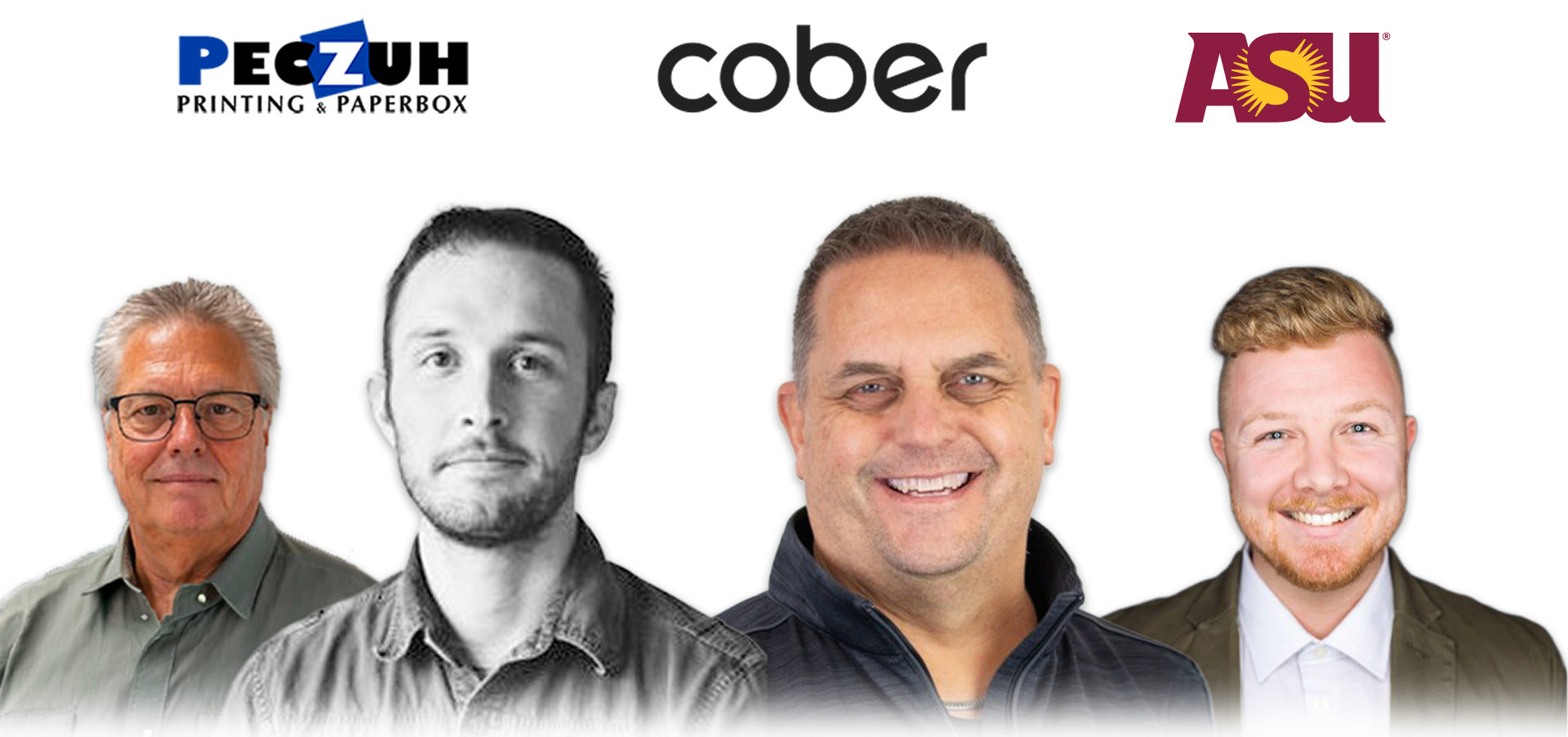
Kyle Pendley, Erwin Driever, and Jay Harris and Jesse Brooks each answered the same question in their own way: what does it take to turn a storefront into production infrastructure. Automating the front end just moves the bottleneck downstream. The people who understand how every system connects are what holds it together.

ASU Print and Imaging Lab
Serves 215,000 students, faculty and staff, entirely self-funded. Kyle Pendley’s team competes for orders against outside vendors that every one of its 300 departments and 100-plus student organisations could use instead. A business card order can now go from click to press in minutes.

Cober Solutions
Erwin Driever’s team evaluates every platform on one question: can it integrate into what’s already running. Cober now runs 15 direct brand integrations and processes 350 publications a month through litho, with 95% automation across digital, warehousing and fulfilment.

Peczuh Printing
Jay Harris runs the MIS side from Salt Lake City, Jesse Brooks runs web-to-print from Maine. Between them: 22 B2B storefronts, including a Children’s Miracle Network portal serving 141 hospitals. Orders reach the press as print-ready PDFs with no human touch before it.
The Integration Series Roundtable
Hear directly from the people in these stories
Kyle Pendley, Erwin Driever, Jay Harris and Jesse Brooks join Infigo’s Greg Young and Dscoop’s Peter van Teeseling for a live roundtable on 10 September at 4pm BST. Bring your own integration questions and compare notes with the people who’ve lived through it.
FAQ'S
Book a demo
Frequently Asked Questions
Didn't find the answer?
No worries! If you have any other questions or need more information, feel free to reach out directly. We’re always happy to help and make sure you feel confident. Let’s chat!
-
Across ASU’s Print and Imaging Lab, Cober Solutions and Peczuh Printing, integration kept resurfacing as a decision that never finished. Each business found that solving one connection point (storefront to MIS, for example) shifted the bottleneck somewhere else (finishing, fulfilment, customer support), so integration stayed an ongoing infrastructure investment rather than a single implementation project.
-
Cober Solutions runs 75 to 80% automation on litho and around 95% on digital, warehousing and fulfilment. Peczuh Printing’s storefronts get orders to press as print-ready PDFs with no human touch before the press itself. Neither started there. Both built toward it over years, not months.
-
Erwin Driever at Cober Solutions has been direct about this: ‘If you can’t integrate into an existing system in some form or fashion that hopefully is relatively easy, it’s just not worth the effort to even look at or invest in.’
-
Kyle Pendley (ASU), Erwin Driever (Cober Solutions), and Jay Harris and Jesse Brooks (Peczuh Printing) join The Integration Series Roundtable, hosted by Infigo’s Greg Young and Dscoop’s Peter van Teeseling, on 10 September at 4pm BST. See the roundtable section above for registration.
Integrations Hub
See what Infigo actually connects to
MIS, payment providers, shipping carriers, and a documented API for anything not listed. The same integration layer behind every story in this series.

Latest Posts
02/09/2026
DSCOOP Integration Series: What 3 PSPs Learned
See how ASU, Cober Solutions, Peczuh Printing and others turned integration into core infrastructure, not an afterthought. Real decisions, real results.
Read More
31/08/2026
Print Ready: How Eshuis Gave Its Enterprise Customers a Faster Way to Order
A 130-year-old Dutch label converter serving Coca-Cola and Heineken finds a simpler path for enterprise customers, by giving them a choice the platform never offered before.
Read More
17/08/2026
How The Big Display Company turned complex wide-format into click-and-buy
When The Big Display Company decided to modernise how it served its trade customers, it was already a busy wide format specialist based in Slough, England, with a strong reputation for fast, accurate quoting and quick turnaround. The team had invested heavily in HP Latex and dye-sublimation technology and was trusted by resellers across the […]
Read More