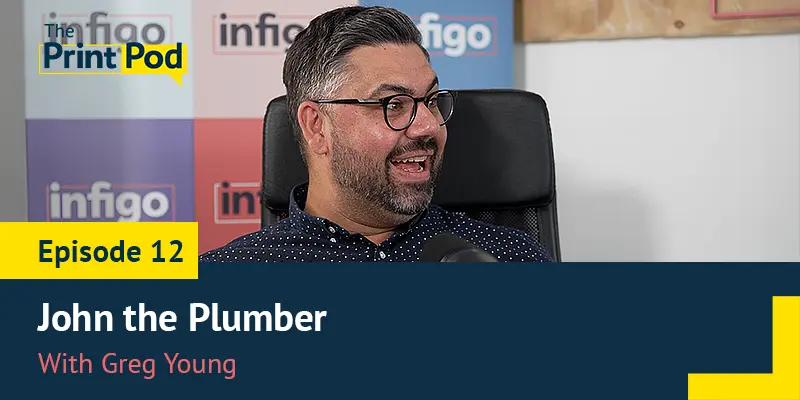
Greg expands on how a storefront tailored for customers, like John, can grow revenue beyond the initial order. For instance, while John might come for business cards, the storefront can cross-sell additional products like flyers, Christmas cards, or banners. This ‘shop window’ effect encourages repeat business and fosters brand loyalty, helping PSPs identify new revenue streams.
He shares a case study about a car dealership that originally ordered only business cards through a storefront. After the PSP added brochures, pull-up banners, and calendars, the dealership significantly increased its orders, making the storefront a valuable resource for diverse print needs.
Shared storefronts for small customers
For clients with a minimal print spend, Greg advocates for shared storefronts instead of dedicated ones. This approach reduces the onboarding effort for the PSP, while still offering small customers an efficient, branded ordering experience. He highlights a successful example of one shared storefront, servicing 195 different businesses and demonstrating the scalability of this model.
Greg said: “John doesn’t have his own dedicated storefront. He goes on this shared entity, which means that in terms of onboarding, say, ‘Paul the Plasterer’, ‘Joe the Chef’ and ‘Eric the Electrician’, it’s a much simpler route to market as the PSP.
“You’re not building a storefront from the ground up and branding it as John the Plumber, because John doesn’t warrant having his own fully branded storefront, if he’s only buying from you twice a year.
“So instead, if you embrace our access permissions functionality within our platform and build up our access rules, when John next logs on, he only sees business cards, as well as selected generic products, such as a pull-up banners, maybe Christmas cards and a quoting pad, or whatever the next thing is. So you’ve got your ‘John specific’ template of products, as well as your generic ones. The best part is, there’s is no limit to the number of John the Plumbers you can take on.”
Automation and workflow optimisation
Profitability hinges on automation, especially for low-value orders. Greg shares a success story of a Stateside PSP that achieved profitability on a $20 business card order, by integrating their web-to-print platform with workflow automation tools, such as Enfocus Switch, thanks to our dedicated Connect: Switch integration.
This set-up removed manual touchpoints, enabling files to go straight from order to production, without pre-press intervention. Automation ensures efficiency, freeing up staff for higher-value tasks, whilst still maintaining a seamless customer experience for the end-user.
Strategic thinking and the “touchpoint challenge”
During the session, Greg introduces the ‘touchpoint challenge’, a diagnostic exercise to identify inefficiencies in the production process. By mapping every interaction—from order inquiry to delivery – PSPs can uncover bottlenecks in operations and optimise workflows, making even small jobs profitable.
Greg said: “Get a sheet of paper and draw a line down the middle of it. Then, at the top of the line, write ‘order inquiry’ and at the bottom of the line, ‘goods received and in your hands’, then note every single time there is an interaction – whether it’s from someone touching the job in production, a phone call, replying to an email, if it’s gone into an approval workflow and been rejected, meaning an account manager has to pick it back up again, contacting to the customer etc. Jot it all down and send it over to us. We’ll analyse and review it all for you.”
Building ‘sticky’ relationships
The episode emphasises the importance of making PSPs ‘sticky’ for their customers. By offering easy-to-use platforms and tailored services, PSPs reduce the likelihood of clients switching to competitors. A robust web-to-print experience mimics the Amazon-style convenience customers expect, solidifying long-term relationships.
Greg said: “We feel that the deeper and the wider the implementation of Infigo is within an organisation, the more difficult it is for the end-user to decide to go elsewhere. We provide the tools to our customers to make it a fantastic experience.
“We often talk about an Amazon-like experience. Everyone who fires up Amazon on their phone, or goes on their laptop, then within 10 minutes you found the item and checked out, had two emails telling you it’s been placed and it’s about to be shipped.
“They’ve set a precedent in terms of how ordering process and ordering journey looks like.”
Looking ahead: Sustainability and innovation
The episode also touches on industry trends and new initiatives. Greg discusses Infigo-eco, an environmental program that plants a tree for every new storefront launched on Infigo’s platform. This initiative highlights the company’s commitment to sustainability.
Additionally, Greg previews exciting developments, including our dedicated integrations with Enfocus Switch and expanded functionality for PSPs. He also hints at upcoming launches at industry events, such as PRINTING United Expo and Labelexpo.
Listen now on Spotify and YouTube
Infigo’s PrintPod podcast consistently delivers industry insights. So, to hear more from the podcast, make sure you subscribe through our YouTube or Spotify channels, for regular updates on the latest trends in print and business in general – from industry leaders to those taking up their first role in the print industry and everyone in between.